Posts Tagged With: the garden maiden

Blooming in My Yard: March 15-21, 2014

What's Blooming in My Yard. TheGardenMaiden_copyright_2014_RStafne-109_WEB

What’s Blooming in My Yard. TheGardenMaiden_copyright_2014_RStafne-109_WEB

This week I have seven flowers to share with you from what is blooming in my Mississippi yard.  The first is the image above of the iris growing at the base of an oak tree. I was so excited to see them open on Thursday. They have a very soft fragrance and really thrive at the base of the tree.  These iris were already growing there when I moved to the house. I have no idea which variety, but to me it doesn’t matter as much as just having them here as I left about seven different varieties of iris at my previous home in Oklahoma, most of which it seems were destroyed by the new homeowners, I was sad to see.
What's Blooming in My Yard. TheGardenMaiden_copyright_2014_RStafne-109_WEB

What’s Blooming in My Yard. TheGardenMaiden_copyright_2014_RStafne-109_WEB

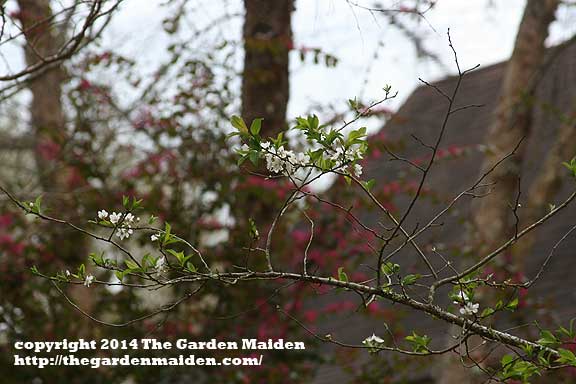
The second image  is a very old apple tree, with just a small bit of life left in its tired old bones.  I cannot bring myself to cut it down, but I have planted a fig near the base with the hopes that it will be able to take over and replace the apple tree when it finally gives up the ghost. Its always good to plant for the future.

What's Blooming in My Yard. TheGardenMaiden_copyright_2014_RStafne-109_WEB

What’s Blooming in My Yard. TheGardenMaiden_copyright_2014_RStafne-109_WEB

A member of the Rosaceae family just like the apple tree above, these dewberries are flowering prolifically around my yard (sometimes to my dismay) and along roadsides throughout the region.  One can often find members of the same plant family blooming at the same time.  Dewberries produce edible fruit if you can get them before the birds or other animals. Growing along the ground, they make for easy pickens. Dewberries, Rubus trivialis, are native plants. Read more about dewberries on Wildflower.org.

What's Blooming in My Yard. TheGardenMaiden_copyright_2014_RStafne-109_WEB

What’s Blooming in My Yard. TheGardenMaiden_copyright_2014_RStafne-109_WEB

Dianthus, pinks, are beginning to flower. This winter they only rested from flowering for about six weeks, though the past two winters, they produced a bloom or two all winter. Growing in a half-whiskey barrel, these hardy gems are easy to grow and trouble-free. I deadhead them throughout the year to keep them flowering. The only trouble I have had with this planting were fireants that made their home in the pot. I have treated them successfully with fireant powder once per year. Fireants and poison ivy…two garden pests I despise and treat.

What's Blooming in My Yard. TheGardenMaiden_copyright_2014_RStafne-109_WEB

What’s Blooming in My Yard. TheGardenMaiden_copyright_2014_RStafne-109_WEB

The following three plants are natives that you may be missing in your lawn or garden if you apply herbicides and/or grow a monocultured lawn. The image above is known as lyreleaf sage or cancer weed, a member of the Lamiaceae family (mint, henbit and dead nettle family), one of my favorites for spring. Grab your hand lens and observe the tiny flowers closely. The family for these plants is also referred to sometimes as labiate due to the flower structure (2-lipped). They are magnificent and typical of the family. A native perennial, Salvia lyrata, makes a nice groundcover! Are you familiar with the groundcover called ajuga? Well, this has a very similar growth habit because they are in the same family! Wildflower.org reports this to be a good plant for butterflies and hummingbirds. As with most members of the mint family, there are many herbal medicinal references for Salvia lyrata if you search the web.

What's Blooming in My Yard. TheGardenMaiden_copyright_2014_RStafne-109_WEB

What’s Blooming in My Yard. TheGardenMaiden_copyright_2014_RStafne-109_WEB

Why I am nearly positive the plant above is Erigeron quercifolius (oakleaf fleabane), I can tell you for certain it is a member of the Asteraceae family. The leaf shape is distinctive which is why I believe it to be E. quercifiolius, and not one of the other Mississippi native Erigeron species. This plant grows in partial shade near the plant above, close to a sidewalk. After flowering I will go ahead and mow them down. Wildflower.org reports this plant to be a host for beneficial insects.  Another good reason NOT to spray herbicides on your lawn to create some fakey “perfect” portrait of what someone has told you a lawn should look like.
What's Blooming in My Yard. TheGardenMaiden_copyright_2014_RStafne-109_WEB

What’s Blooming in My Yard. TheGardenMaiden_copyright_2014_RStafne-109_WEB

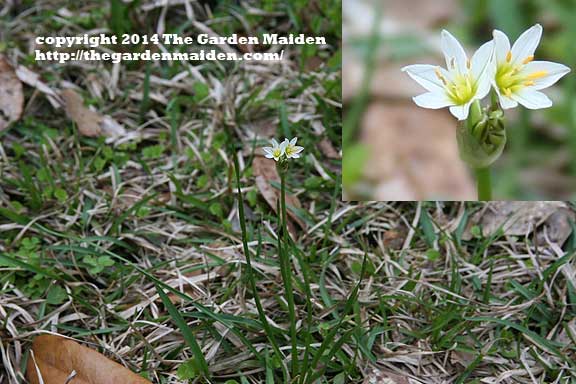
My final flower for the week is a member of the Liliaceae family (a monocot).  Pictured above, Nothoscordum bivalve (as known as Allium bivalve) is commonly known as false garlic or crow poison. This dainty, perennial bulb can be found popping up in lawns or along roadsides. It is a native plant for Mississippi. I mow around these little guys until they are finished flowering.

When keying out plants, having a great resource is invaluable. Although I have not yet found a printed key for Mississippi, I can usually get to the “family” using my KEYS TO THE FLORA OF ARKANSAS. This book was written by one of my professors at the University of Arkansas, Dr. Edwin B. Smith. Additional resources for Mississippi native or wildflower identification can be found on USWildflowers.com (or your state).

If you happen to find an error in plant identification, let me know. I do try to verify all plants and plant names with at least three sources, but mistakes happen.  I love to learn if you know something I’ve missed.

Another day of planting awaits! I put together a few more raised beds yesterday and need to get them planted today. Rain comin’ on Sunday! Happy SPRING ya’ll!

Keep on Growin’
The Garden Maiden

All images and text copyright 2014 The Garden Maiden
Categories: What's Blooming | Tags: , , , , , , , , , , , , , , | 1 Comment

“Ooooh, that smell, the smell of death surrounds you” Clathrus!

Stinkhorn. TheGardenMaiden_copyright_2014__RStafne-005a_WEB

Stinkhorn. TheGardenMaiden_copyright_2014__RStafne-005a_WEB

“Ooooh that smell
Can’t you smell that smell
Ooooh that smell
The smell of death surrounds you”
Lynyrd Skynyrd – That Smell Lyrics

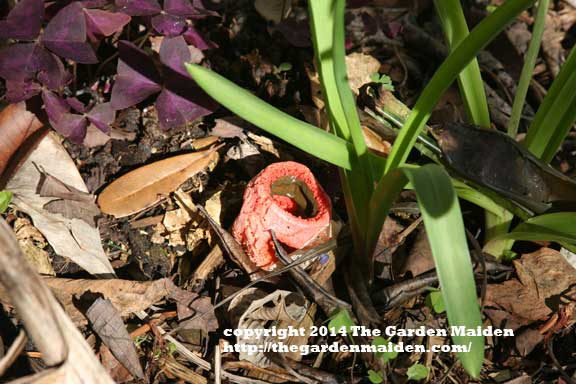
Last week, in my Blooming in My Yard post, I included a nasty little thing called a stinkhorn. A few days after taking the photo, the mushroom was gone, thank goodness. So it came as a surprise this morning, whilst sweeping my patio and throwing bits of dead plant debris into a nearby raised bed, that my nostrils were suddenly accosted by some offensive odor. At first I assumed I was catching an occasional drift from the nearby blooming pear trees (another notoriously nasty spring smell). However, as I continued to sweep and gag, I decided to poke around the nearby flower beds.

That’s when I spotted it, another stinkhorn! I must have hit it with a piece of plant debris and encouraged it to release its stench more quickly or perhaps just more concentrated toward my general direction.

Stinkhorn. TheGardenMaiden_copyright_2014__RStafne-005a_WEB

Stinkhorn. TheGardenMaiden_copyright_2014__RStafne-005a_WEB

It looked a wee bit different from the Clathrus columnatus I found last week growing out in the yard, but yet they are the same species. There is variation in how they appear. The link above will connect you to mushroomobserver.org. Good information!

Stinkhorn. TheGardenMaiden_copyright_2014__RStafne-005a_WEB

Stinkhorn. TheGardenMaiden_copyright_2014__RStafne-005a_WEB

Notice the brown mucous/wet mud-looking stuff inside.  I have to admit, if you look at a close-up, I could have perhaps began this post by telling you I had cooked up a strawberry gelatin desert with chocolate pudding on the inside. Would you have said “oooh and ahhh” as you imagined each tasty bite? Ha ha ha , but I digress.

Now, as a scientist, I ask myself, what makes them appear in my yard or flower bed?  Most plants like this that appear and disappear grow during periods of heavy rainfall or during a drought…environmental triggers that tell the plants “its time to roll”. Of course, most of us know that plants that stink to high hell do so to attract pollinators! For example, what kind of things are attracted to rotted meat? …Exactly.

There is a 2013 post from Dr. Dan Gill, LSU Ag Center Horticulture Specialist, in the NOLA.com online newspaper with the Times Picayune. The article is titled, “Too Much Rain Can Be Stressful”.  He is their garden columnist and provides wonderful information. In it you will see another image of octopus or squid stinkhorn (Clathrus columnatus). That image looks a bit more like my image from last week.  Dan adds some useful information regarding this species: Fortunately, stinkhorn fungi do not cause plant disease or injure ornamental plants. They simply grow as saprophytes, obtaining their nutrients by decaying dead plant material, such as wood mulch, buried wood debris or rotting dead tree roots. There are no chemical control measures. Fungicides available at nurseries will not eliminate this fungus. However, to reduce the likelihood of their reappearance, you can try to limit their food supply. Hardwood bark mulch can be removed and replaced with pine needles, or try to dig up and get rid of buried wood or large dead tree roots.” 

For me, these mushrooms are an occasional nuisance, and certainly nothing to get excited about. If I were, say, hosting a party on the patio today, I would grab my shovel, remove the offender and throw it over in some remote corner of my yard. You might be able to play a “good” practical joke on someone with one of these too.

To get a bit more botanical, I will tell you these particular mushrooms I have shared are a member of the Clathraceae family, but stinkhorns in general can be of Clatheraceae or Phallaceae.  Mushroomexpert.com goes into some great detail and mentions the battle of classification for this mushrooms, battles that sometimes exits in the plant taxonomic world. On their website there is a great page with images folks have submitted. I am sure if you think you have a stinkhorn, you will find a similar image on that album page. So check it out. Some of them are very beautiful and some are very naughty-looking (phallic).

Well, another hour has passed of me working on this blog post when I was supposed to be working on my raised beds and planting seed! I hope that someone will get something useful or entertaining out of this post about the stinkhorn.

One final note, on the Mississippi Gulf Coast or surrounding regions you might consider joining The Gulf States Mycological Society, if you have a good interest in all things shroomy! Well, maybe not ALL things shroomy. 🙂

Another great resource is Dr. Juan Luis Mata at the University of South Alabama. He typically speaks and leads a mushroom walk at The Crosby Arboretum in the late summer.

Keep Growin’
The Garden Maiden

All images and text copyright 2014 The Garden Maiden

Categories: Crazy Plant Things I See, Observations from My Garden of Goods & Evils | Tags: , , , , , , | Leave a comment

Blooming in My Yard: March 8-14, 2014

TheGardenMaiden copyright 2014, Spring blooms in my Mississippi yard

TheGardenMaiden copyright 2014, Spring blooms in my Mississippi yard

Often times (and sadly so) pulled out or sprayed with herbicide by many folks, this pink-flowering Oxalis wildflower pops up all over my patio garden each spring. I wouldn’t dream of spraying it out (of course I don’t like to spray anything except poison ivy), but I have occasionally moved it to a better home. And guess what? Its edible! I love the blog post on Oxalis written on Eat The Weeds. At any rate, it just started blooming in my garden this week! But in a couple of weeks there will be a plethora of pink flowers. The benefits are that it is very low maintenance, low growing, and will grow in cracks or other hard-to-plant areas.

TheGardenMaiden copyright 2014, Spring blooms in my Mississippi yard

TheGardenMaiden copyright 2014, Spring blooms in my Mississippi yard

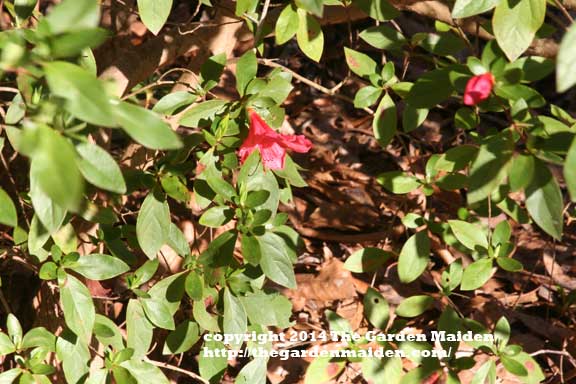
The very first blooms of my rhododendrons have opened. They are a couple of weeks from peak (the perfect time for a garden party), but these blossoms will tease me until then. Remember, if in doubt, just call it a rhododendron, because “All azaleas are rhododendrons but not all rhododendrons are azaleas.” This is because their genus is Rhodendron. Read more about their classification on www.rhododendron.org.  I am so lucky that in times past someone did a wonderful job of planting trees, shrubs, and perennials in my yard. I repay the kindness by planting more as I am able for future homeowners to admire and love.

TheGardenMaiden copyright 2014, Spring blooms in my Mississippi yard

TheGardenMaiden copyright 2014, Spring blooms in my Mississippi yard

The wild, native Prunus pictured above, likely Prunus serotina (black cherry) is blooming now too. Although this tree is growing on adjacent property, it is full evolved onto my property. However, there are seedlings that pop up everywhere, so I may be inclined this year to dig up a couple and plant out in my yard. Otherwise, they usually end up chopped up with the lawnmower or victim to the compost.  Read Dr. Eric Stafne’s blog post on wild prunus. Look for this tree blooming in the woods on your spring hikes!

TheGardenMaiden copyright 2014, Spring blooms in my Mississippi yard

TheGardenMaiden copyright 2014, Spring blooms in my Mississippi yard

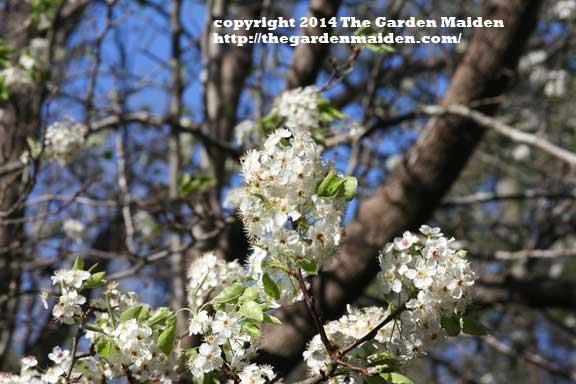
Last week I showed images from my fruiting pear and one of the pollinator pears. The pollinator image above is my second pollinator pear and just started flowering this week. It is likely a different species, although it does get a bit more shade, both factors that can affect timing of flowering. As with the other pear used for pollinating, it flowers first, then the leaves will emerge.

TheGardenMaiden copyright 2014, Spring blooms in my Mississippi yard

TheGardenMaiden copyright 2014, Spring blooms in my Mississippi yard

The blueberries are blooming! Both native, such as Vaccinium elliottii, and the cultivated blueberries (above) are flowering. I love their dainty, hanging, bell-like flowers that seem to shimmer in the morning sun. Both are edible! If you are interested in fruit and nut crop information, considering following Dr. Stafne’s blog, which includes information on blueberries. Be on the look for this native blueberry blooming this month if you are out hiking.

TheGardenMaiden copyright 2014, Spring blooms in my Mississippi yard

TheGardenMaiden copyright 2014, Spring blooms in my Mississippi yard

Whew! Can you smell it? Okay, okay, so its not your typical “flower”, but this final gem pictured above is a fungi that emerged near my raised bed. Known commonly as a stinkhorn, I am pretty sure it is of the genus Clathrus. ? Some good information with images can be found on East Tennessee Wildflowers: Fantastic Fungi! This is the second one in my yard this spring.

Its a beautiful day outside and I have a ton of work to do and now half the day is gone from me!

Have a great weekend and try to enjoy some St. Patrick’s Day parades!

Keep Growin’
The Garden Maiden

All images and text copyright 2014 The Garden Maiden

Categories: What's Blooming | Tags: , , , , , , , , , , , | 2 Comments
Pollinator Gardens.org

Enhancing pollinator habitat through research, education and design

Keep Mississippi Beautiful

Working to inspire and educate Mississippians to take action everyday to impact, improve, and beautify their community environment.

Fire Gardens: fire-generated grassland seed

Louisiana Cajun Prairie and Pine savanna seed

Easy Wildflowers

Wild flowers from The Forest of Dean

Always Growing

A garden is good for both body and soul

In the Garden with Arkansas Extension Horticulture

Welcome to In the Garden with Arkansas Extension Horticulture, a blog about gardening in Arkansas.