Author Archives: thegardenmaiden

Unknown's avatar

About thegardenmaiden

Garden Writer, former USDA-ARS Biological Science Technician, Certified Professional Horticulturist, ISA Certified Arborist SO-7200A with a B.S.A in Landscape Design and an M.S. in Horticulture.

Are “Sustainable” and “Organic” Synonymous?

Great post. One might attempt to grow something organically, but it might not be sustainable for where they live or the inputs used (fertilizer, pest treatment, water quantity) might not be sustainable. Would it be sustainable to grow a high-water-requiring crop such as watermelon organically in the desert? Probably not. Organic or non-organic, probably not sustainable. Would it be sustainable to organically grow giant pumpkins using organic fertilizers that are shipped in from across the U.S. or another country? No, of course not. If you can grow organically using local resources (seed, fertilizer, pest control, hardscape materials (fence, wire, blocks, irrigation supplies), re-purposing used materials, minimizing your footprint on the land, recycling, using water wisely, reducing erosion, reducing water, fertilizer, pesticide runoff, etc and giving back to the soil and nature, then you are attempting to be more sustainable and you can do it organically. If your harvest is sold locally rather than trucked six hours a way for resale, that is more sustainable. If you grow organically and your produce is shipped from Mississippi to Minnesota, not very sustainable . Of course if you use electric cars to ship your product that is more sustainable than fossil fuels. Make sense?

EStafne's avatarMississippi Fruit and Nut Blog

I was recently at a meeting where the terms “sustainable” and “organic” were used interchangeably.  I found this interesting.  Are they really synonymous?  First we should define these terms.  According to the Merriam-Webster online dictionary, sustainable means:

1. capable of being sustained
2 a : of, relating to, or being a method of harvesting or using a resource so that the resource is not depleted or permanently damaged 
b : of or relating to a lifestyle involving the use of sustainable methods

As for organic, we need to target the definition to deal with food only (as there are other definitions not pertinent to our discussion here):

1. Of, relating to, yielding, or involving the use of food produced with the use of feed or fertilizer of plant or animal origin without employment of chemically formulated fertilizers, growth stimulants, antibiotics, or pesticides

So, could an organic food system be sustainable?…

View original post 132 more words

Categories: Uncategorized | Leave a comment

Bayou Sauvage NWR and Fort Pike SHS, Louisiana: Spring Flowers in Bloom

Visit to Bayou Sauvage and Fort Pike, Louisiana.

Visit to Bayou Sauvage and Fort Pike, Louisiana.

Recently I made a spring jaunt over to southeast Louisiana to visit the Bayou Sauvage and Fort Pike State Historic Site ($4 and no pets allowed in fort). My husband and I only saw a couple of alligators, from far away (see photo above).

Visit to Bayou Sauvage and Fort Pike, Louisiana.

Visit to Bayou Sauvage and Fort Pike, Louisiana.

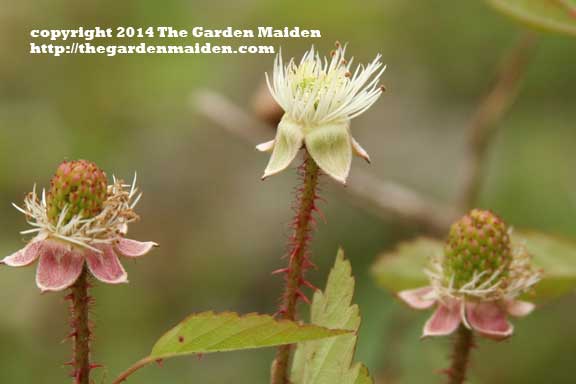
Below are images of a few flowering plants and a few critters I saw throughout the day. The first image is a member of the Rubus genus, commonly known as dewberry (Rubus trivialis). The fruit were advancing quite well.

Visit to Bayou Sauvage and Fort Pike, Louisiana.

Visit to Bayou Sauvage and Fort Pike, Louisiana.

At the Bayou Sauvage we made three different entrance stops. Each area had its own unique attribute, whether a good spot for setting in a kayak, outstanding birding, or a a lengthy boardwalk that traversed a unique ecosystem of the Gulf Coast. I had not been to Bayou Sauvage since Hurricane Katrina, in fact I hadn’t been since spring of 1998, long before I ever thought I’d live on the MS Gulf Coast. We were so happy that leashed dogs were allowed. Our pups had a great time and will be back.

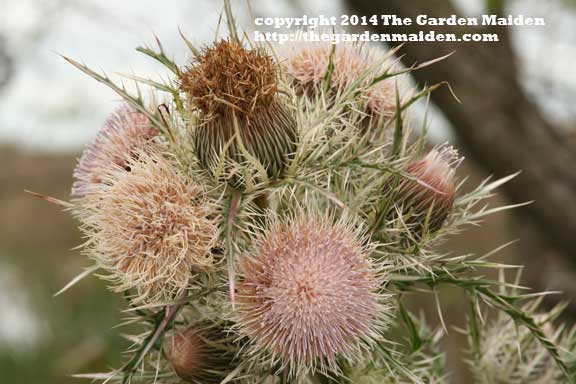
Realizing that most folks will find thistle nasty or hideous, please take a second look. Its gorgeous. In fact it nearly looks like something out of a horror movie or space novel.

Visit to Bayou Sauvage and Fort Pike, Louisiana.

Visit to Bayou Sauvage and Fort Pike, Louisiana.

Just a few steps away, this thistle plant had a different look, but still very pretty. So much detail and texture. Wildflower.org reports that these thistles are important to both native and bumble bees. You might now believe how many thistles there are just in the Cirsium genus alone! I thought perhaps at first the image below might be C. horridulum, but I am not positive. Actually, I really wanted to include that species name. HORRIDulum. LOL Exactly what I can image some tiny lady saying a long, long time ago: (Hmm HORRID plant). Next to this group of thistle were flowering Salix (willow) and you can see the pretty yellow flowers in the slideshow below.

Visit to Bayou Sauvage and Fort Pike, Louisiana.

Visit to Bayou Sauvage and Fort Pike, Louisiana.


Visit to Bayou Sauvage and Fort Pike, Louisiana.

Visit to Bayou Sauvage and Fort Pike, Louisiana.

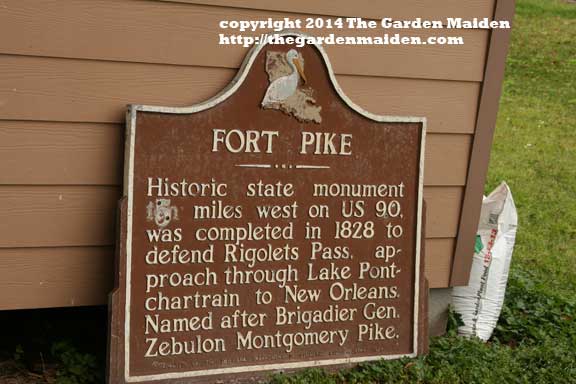
After our first Bayou Sauvage stop, we then drove to Fort Pike. The day was mostly cloudy and cool and it seemed we fought rain off and on all day. The sign below sits outside the tiny visitor center where admission is paid.

Visit to Bayou Sauvage and Fort Pike, Louisiana.

Visit to Bayou Sauvage and Fort Pike, Louisiana.

This view of white-flowered crow poison (Northoscordum bivalve) is from the top of Fort Pike overlooking the water.

Visit to Bayou Sauvage and Fort Pike, Louisiana.

Visit to Bayou Sauvage and Fort Pike, Louisiana.

A low growing groundcover,  Anagallis arvensis (scarlet pimpernel) was flowering atop the fort in the grass. Don’t be fooled by the mixture of species when you view the leaves. Yeah, fooled me too! The orange petals with inner purple marking is very distinctive. I had never seen this plant before. I am really glad I got to know this flower because the name Scarlet Pimpernel has been very familiar to me as a novel, play, and movie, although I confess that I don’t think I have ever read or viewed it.

Visit to Bayou Sauvage and Fort Pike, Louisiana.

Visit to Bayou Sauvage and Fort Pike, Louisiana.

Technically this next image of a fern isn’t “flowering”, but I am sometimes just amused at the cracks and crevices that plants will grow in when they put their minds to it.

Visit to Bayou Sauvage and Fort Pike, Louisiana.

Visit to Bayou Sauvage and Fort Pike, Louisiana.

The Fort was really cool and I was glad to get to see it. The Gulf Coast sports many wonderful, historic forts so be sure to look them up if you are in the area.

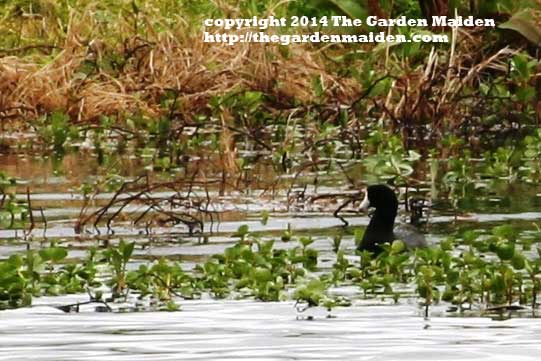
Next we headed back for our second and final stops at the Bayou Sauvage, both of which had boardwalks that afford opportunities to see and photograph alligators, waterfowl and other aquatic birds and animals.

At several places we noticed the pretty blue flowers of Tradescantia, the native spiderwort. We weren’t the only ones to take note though (see image in slideshow of butterfly on Tradescantia)

Visit to Bayou Sauvage and Fort Pike, Louisiana.

Visit to Bayou Sauvage and Fort Pike, Louisiana.

View these images and more in the slideshow below:

This slideshow requires JavaScript.

Thank you Louisiana Fish and Wildlife Service (and for allowing Bayou Sauvage to be leashed-dog friendly) and the State of Louisiana Historic Sites.

Keep on Growin’
The Garden Maiden

All images and text copyright 2014 The Garden Maiden

Categories: National & State Parks, What's Blooming | Tags: , , , , , , , , , | Leave a comment

Blooming in My Yard: March 29-April 4, 2014

Blooming in my yard. TheGardenMaide_copyright_2014_RStafne-011_WEB

Blooming in my yard. TheGardenMaiden_copyright_2014_RStafne-011_WEB

Friday, March 28, we received our first big spring rain and with some sunshine and warm temperatures, seedlings, new leaves and color are exploding all around.

Blooming in my yard. TheGardenMaide_copyright_2014_RStafne-011_WEB

Blooming in my yard. TheGardenMaiden_copyright_2014_RStafne-011_WEB

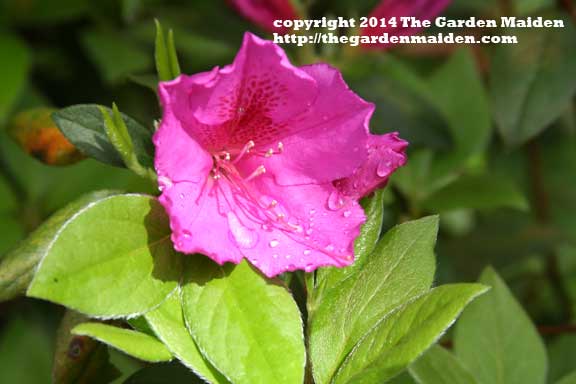
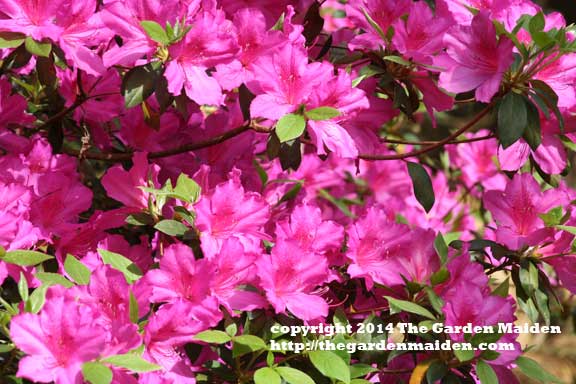
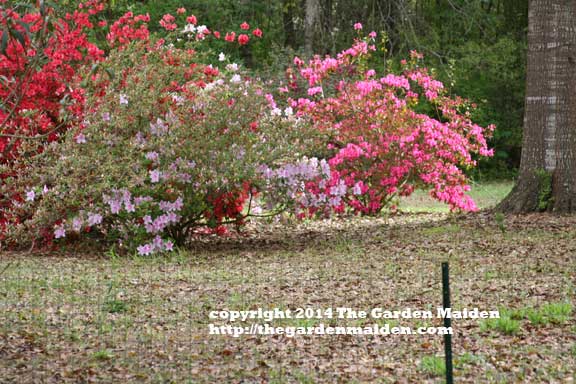
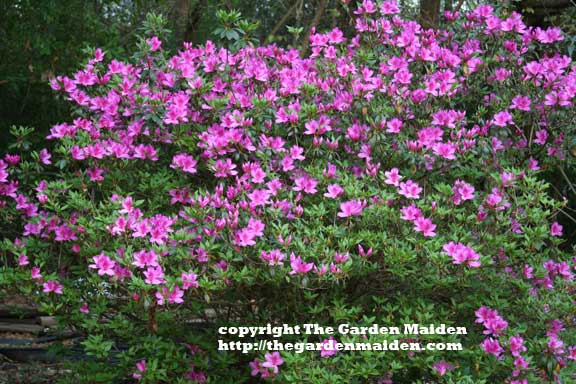
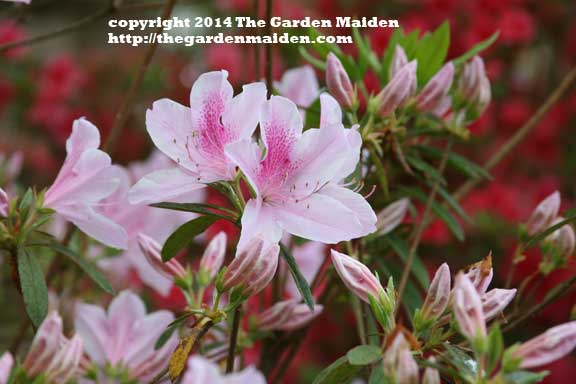
The main eye-catcher in my garden this past week are definitely the Rhododendrons! I have so many different colors. Having many existing Rhodies was one reason for choosing my home. This classic standard for any southern garden provides a spring festival of color for several weeks.

Blooming in my yard. TheGardenMaide_copyright_2014_RStafne-011_WEB

Blooming in my yard. TheGardenMaiden_copyright_2014_RStafne-011_WEB

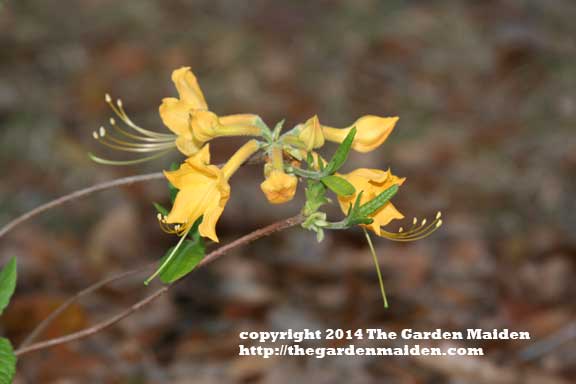
By the end of the week they were really peaking. As I mentioned in an earlier post, all azaleas are in the genus Rhododedron. Classification can be confusing, but according to one of the leading professional horticulturists, Dr. Michael Dirr, in general, true rhododendrons are usually evergreen and azaleas are mostly deciduous.  Rhododendrons usually have ten or more stamens (male parts). Azaleas usually have five stamens, flowers tend to be funnel or tubular and generally have leaves that are pubescent and never dotted with scales. In my own yard I believe I mostly do have evergreen “rhodies”, nearly all of the large flowers have ten stamens. I’ve got deciduous rhododendrons too. Look at the yellow azalea pictured down below on the page. It is a native azalea and you may be able to see it has the classic funnel-form flower and five stamens. That’s an easy one!

Blooming in my yard. TheGardenMaiden_copyright_2014_RStafne-011_WEB

Blooming in my yard. TheGardenMaiden_copyright_2014_RStafne-011_WEB

If you are interested in all things Rhododendron, you might check out the American Rhododendron Society. There are also State chapters.


Blooming in my yard. TheGardenMaide_copyright_2014_RStafne-011_WEB

Blooming in my yard. TheGardenMaiden_copyright_2014_RStafne-011_WEB

I am also excited that my native azalea is still alive and bloomed very well this spring after one year in the ground. Rhodendron austrinum (flame azalea) is a hardy, native, deciduous shrub with outstanding spring color. I highly recommend seeking out both R. austrinum or R. canescens native azaleas for your southern garden, where hardy.

Native azalea blooming in my yard. TheGardenMaide_copyright_2014_RStafne-011_WEB

Native azalea blooming in my yard. TheGardenMaiden_copyright_2014_RStafne-011_WEB

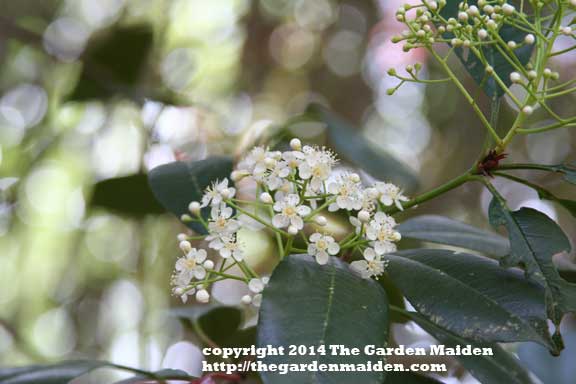
Azaleas weren’t the only things blooming though! My red-tipped Photinia started flowering. There are several species of Photinia. Mine are planted as hedges, which does pose some problems, but for now, still serve their purpose. Clemson University has a good Cooperative Extension handout with information on Phontinia.

Blooming in my yard. TheGardenMaide_copyright_2014_RStafne-011_WEB

Blooming in my yard. TheGardenMaide_copyright_2014_RStafne-011_WEB


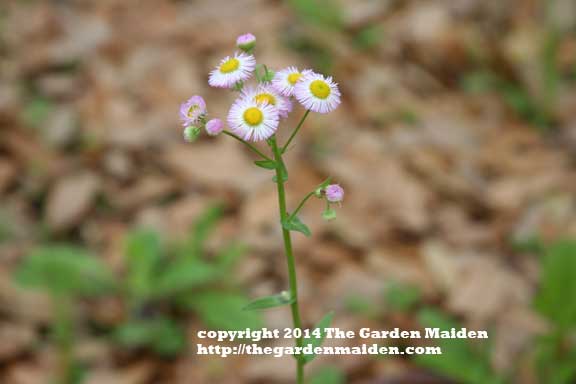
The tiny “daisy-looking” flower below is a native wildflower of the genus Erigeron. Color in the ray flowers varies from white to white with lavender. Once flowering begins to decline I will mow these back to the lawn height. There are at least seven species that bloom in this region in spring.

Blooming in my yard. TheGardenMaide_copyright_2014_RStafne-011_WEB

Blooming in my yard. TheGardenMaide_copyright_2014_RStafne-011_WEB

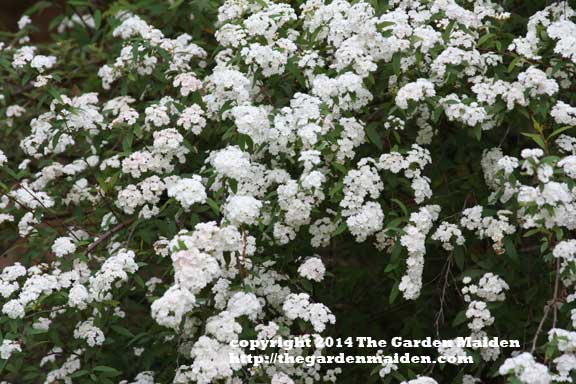
A standard, “old timey” spring, flowering shrub is old-fashioned spirea, usually called bridal wreath spirea, Spirea vanhouttei. Its a graceful, deciduous, arching shrub with clusters of brilliant, white, tiny flowers.

Blooming in my yard. TheGardenMaide_copyright_2014_RStafne-011_WEB

Blooming in my yard. TheGardenMaide_copyright_2014_RStafne-011_WEB

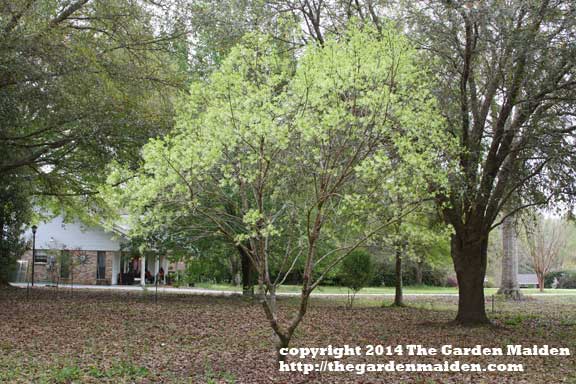
I’m cheating with this next small, flowering deciduous tree as its not fully flowered out, but so close that I could not resist. In the late afternoon sun the flowers of Chionanthus virginicus seem to glow and the chartreuse, spring leaves set the perfect background for the thin, spidery-like flowers. Commonly known as fringe tree or Grancy graybeard, you may see this fine native flowering along roadsides or hiking trails of native plant habitat.  I love to observe this tree from my second-story window in the late afternoon when it really seems to glow.

Blooming in my yard. TheGardenMaide_copyright_2014_RStafne-011_WEB

Blooming in my yard. TheGardenMaide_copyright_2014_RStafne-011_WEB

If my springs posts don’t inspire you to get out and observe what’s blooming in your own yard,  I hope that you can visit nearby parks or gardens to enjoy all that Mother Nature has to offer us in spring 2014.

Keep on Growin’
The Garden Maiden

All images and text copyright 2014 The Garden Maiden


Categories: Observations from My Garden of Goods & Evils, What's Blooming | Tags: , , , , , , , , | Leave a comment
Pollinator Gardens.org

Enhancing pollinator habitat through research, education and design

Keep Mississippi Beautiful

Working to inspire and educate Mississippians to take action everyday to impact, improve, and beautify their community environment.

Fire Gardens: fire-generated grassland seed

Louisiana Cajun Prairie and Pine savanna seed

Easy Wildflowers

Wild flowers from The Forest of Dean

Always Growing

A garden is good for both body and soul

In the Garden with Arkansas Extension Horticulture

Welcome to In the Garden with Arkansas Extension Horticulture, a blog about gardening in Arkansas.