Observations from My Garden of Goods & Evils

New Year’s Compost Resolution: to everything turn, turn, turn.

Compost pile.

Home compost pile.

If you are still looking for ways to celebrate the New Year, in particular, another resolution to add, why not consider composting? It is a great way to recycle and keep waste on your property.

I have been composting for as long as I can remember. As a child, I watched my Grandmother adding kitchen scraps to her compost pile in rural southwest Missouri.

Myself, I’m sort of a lazy composter. In other words, I throw it all out there and then frequently chastise myself for not turning it over more so that it breaks down faster.  I have lived in several states and have had numerous piles. My compost piles sometimes have walls and sometimes are just heaps on the ground. In Oklahoma I was fortunate to purchase a home with a two-chambered compost pile with four foot wooden walls.  I did try one of the plastic barrel-type composters that you spin with your hand. Unfortunately, the clamp for the lid broke off the first year. Then fire ants built a mound on the ground at the base because I wasn’t “spinning” it enough I guess.  They built up into the vent holes along the bottom of the barrel, creating a mess. Disenchanted would describe my experience. I don’t spend much money on my gardening efforts and was excited for this item I budgeted into my plan to produce great piles of brown gold. However, getting the “finished” compost out of the hole was not easy. And frequently, not completely composted. Uggg. Back to a pile on the ground.

I wrote a paper on composting for an English class, back in my junior college days, around 1991.  The ingredients for a compost pile are nearly endless, but you want to avoid meat, cooked broths/gravies, grease, fats, and bones. These items will attract countless animals and do not make good compostable materials.  Occasionally I add hair from the vacuum or trimmings. No I’m not a stylist, I’m just cheap. Depending on the amount of heat created and moisture available (you need both), you can have nice compost created in a few months. Mine tend to take a year.  A spectacular sight to see steam rising from the compost pile on a cold winter’s morn’. Piles that are turned and aerated are rarely smelly. Oxygen is your compost’s friend!

My compost pile is filled with fruit and vegetable scraps, leaves, pine needles, ash (limited quantities only), tea bags, coffee grinds and filters, shredded paper, and well-chopped materials from pruning. Limbs and sticks do not really break down fast enough in my home compost pile, so I exclude those items. I never collect grass clippings as those clippings are needed by the lawn. If you do collect or use grass clippings, be sure they are from chemically untreated lawns. Occasionally my compost pile is filled with wiener dogs, but now that they are aging and one has experienced two bouts of pancreatitis, my husband and I are vigilant about keeping them out. I have some old pallets I have collected and will soon try to create my own compost walls.
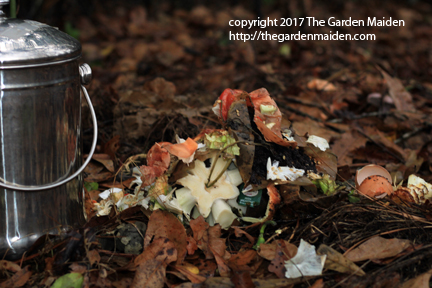
Adding kitchen scraps to the compost pile.

Compost pile.

Currently, I collect my kitchen scraps in a composting pail (in the photo above) that sits on my counter behind the coffee pot. I inherited this can from Mother who isn’t exactly an avid gardener and found the can to be smelly and messy. Not to mention, she doesn’t have a compost pile. A gift well-intended that found its way into my loving arms.  The filter in the compost can was a good idea fraught with troubles.  First, the fruit flies were TERRIBLE. My goal was to dump the can at least every week. It never failed that the can was filled with fruit fly larvae which always made me gag. The fruit flies also laid eggs in the filter system in the lid, no matter how frequently I washed and dried it. In addition, the can STUNK, even with the filters.  In a last ditch effort to make the can efficient, I took some regular, clear masking tape and taped over the ventilation holes on the top of the lid.  This made the compost can a 100% better tool, virtually eliminated the fruit fly issue (I cannot even recall the last one I have seen) and took care of the “smell”. I have been using it now for about four years. Prior to that time I used a small beverage pitcher with a lid. I still try to empty my compost pail every few days, but when it has been a week, I am no longer greeted with a nauseating sight of “movement” from house fly maggots and fruit fly larvae.

Tip: after dumping the can into the compost pile, I walk over to one of my rain barrels (not all are “barrels”), fill it up with water to swish and rinse and dump that into the closest garden bed.  Thus the can returns to the kitchen in a pretty clean state. Should I decide to scrub it with soap in the sink, the compost debris is already gone, making cleanup a breeze.

For more reading on building your own compost pile, the University of Illinois Extension Service has a informative page: https://web.extension.illinois.edu/homecompost/building.cfm

I hope you can find refuge in your refuse. As the Byrds sang, “to everything turn, turn, turn”…and so goes the compost pile.

The Garden Maiden

copyright 2017 The Garden Maiden  http://thegardenmaiden.com
Categories: Observations from My Garden of Goods & Evils | Tags: , | Leave a comment

Blooming in My Yard: January 4-10, 2015- It’s carnival time!

The Christmas decorations have been put away. The Mardi Gras decorations box is in the front room. January 6 is the Epiphany, Three Kings Day, the first day of Carnival season!

Its hard to be gloomy and down when the sun is shining on the Gulf Coast and the temperatures reached into the 60’s. What a beautiful day to hang laundry, wash the car and see what’s blooming around the yard. “Oh well, its carnival time and every body’s havin’ fun.”


Blooming in My Yard, January 4-10, 2015.TheGardenMaiden_copyright_2015

Blooming in My Yard, January 4-10, 2015.TheGardenMaiden_copyright_2015

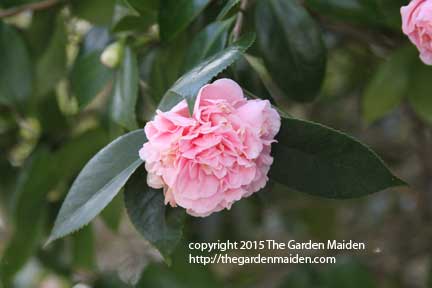
Though my camellias (C. japonica above) started blooming in November, they are really glorious now. I do need to fertilize some of the C. japonicas as many of the leaves are showing nutrient deficiencies. Watch an entertaining little video from Monrovia nurseries about the C. sasanqua and C. japonica. I still have much to learn about the different varieties. If you are really interested in camellias, check out the American Camellia Society. One challenge when coming into an existing landscape without plant labels or a planting plan, is that exact identification can be very tricky, heck sometimes getting the right species is tricky. Below is my other type of camellia. It blooms a bit earlier and I think it to be C. sasanqua.

Blooming in My Yard, January 4-10, 2015.TheGardenMaiden_copyright_2015

Blooming in My Yard, January 4-10, 2015.TheGardenMaiden_copyright_2015

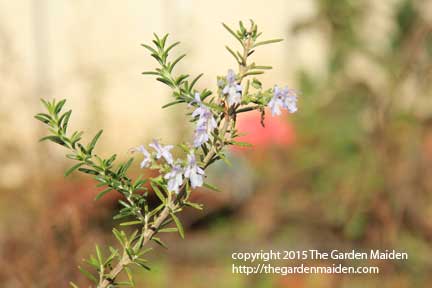
Also blooming right now is my rosemary, a shrub rose and my purple shamrock (Oxalis spp.), all pictured below.

Blooming in My Yard, January 4-10, 2015.TheGardenMaiden_copyright_2015

Blooming in My Yard, January 4-10, 2015.TheGardenMaiden_copyright_2015

Blooming in My Yard, January 4-10, 2015.TheGardenMaiden_copyright_2015

Blooming in My Yard, January 4-10, 2015.TheGardenMaiden_copyright_2015

Blooming in My Yard, January 4-10, 2015.TheGardenMaiden_copyright_2015

Blooming in My Yard, January 4-10, 2015.TheGardenMaiden_copyright_2015

There are still a few flowers opening on my loquat tree (below) and hopefully if it doesn’t get too cold later this week, we’ll have fruit again. Last year the fruit froze and we didn’t get any harvest. MS State Extension has a publication on growing this tree in the landscape. Hmmm, that tree in the publication looks familiar?! 🙂

Blooming in My Yard, January 4-10, 2015.TheGardenMaiden_copyright_2015

Blooming in My Yard, January 4-10, 2015.TheGardenMaiden_copyright_2015

Never failing, even with neglect, tiny Dianthus have showy hot pink flowers, nearly year-round.

Blooming in My Yard, January 4-10, 2015.TheGardenMaiden_copyright_2015

Blooming in My Yard, January 4-10, 2015.TheGardenMaiden_copyright_2015

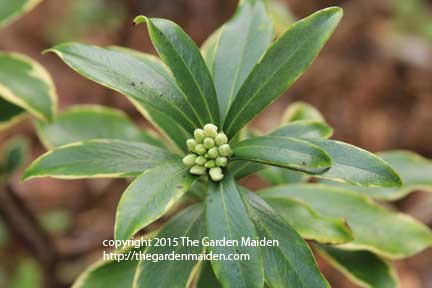
Okay, technically, the plant below isn’t FLOWERING, its in BUD stage. But I’m sure it will open by week’s end. Its my lovely Daphne odora. I’m looking forward to those fragrant, creamy flowers.

Blooming in My Yard, January 4-10, 2015.TheGardenMaiden_copyright_2015

Blooming in My Yard, January 4-10, 2015.TheGardenMaiden_copyright_2015

Speaking of fragrant flowers in January, this little rascal below was cut down in the spring of 2012 as I learned of its invasiveness. I was bummed because its citrus-flower-like perfume is so enchanting. I stuck a tiki birdbath on its stump and it has grown back and around the tiki, giving the tiki statue a hidden “in the jungle” appearance. I should cut its sprouts back again…I really should…HOWEVER, I just learned that the person who identified this plant and said it was invasive, was incorrect. This plant is apparently Osmanthus, tea olive or sweet olive. It has leathery, opposite, deep green, toothy-margined leaves and the shrub is/was evergreen.  I just had a feeling about that plant! So now what? Well, I’m going to move the tiki to the side, beg the plant’s forgiveness, and do my best to mother it back into a beautiful shrub. In addition to the link from Clemson University Extension above, the University of Florida also has some great information on Osmanthus. I cut down a 8′ beautiful shrub based on someone’s incorrect ID! I feel like Sally in The Great Pumpkin Charlie Brown “What a fool I was!”  Well, that’s what happens when you are new to an area and aren’t familiar with all the plant material.

Blooming in My Yard, January 4-10, 2015.TheGardenMaiden_copyright_2015

Blooming in My Yard, January 4-10, 2015.TheGardenMaiden_copyright_2015

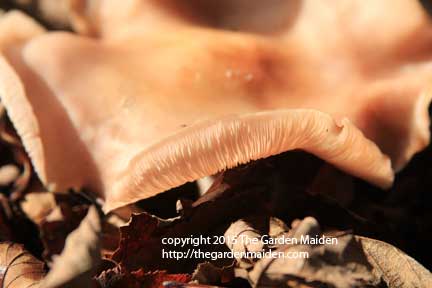
Finally, NOT a flower. A lovely fungi. I have a full-color mushroom identification guide on order. I find some of the most amazing fungi in my yard but I want to identify them all. Who knows, maybe I’ll be able to eat some of what I have growing in my yard! Do YOU know what this mushroom is?

Blooming in My Yard, January 4-10, 2015.TheGardenMaiden_copyright_2015

Blooming in My Yard, January 4-10, 2015.TheGardenMaiden_copyright_2015


I hope your winter is as colorful as mine. Mild Gulf Coast winters help make cooler months more beautiful!

Yours in Gardening!

The Garden Maiden 🙂

All images and text copyright 2015 The Garden Maiden

Categories: Observations from My Garden of Goods & Evils, What's Blooming | Tags: , , , , , , , , , | 1 Comment

A Couple of Plants for a Supermoon Garden: a marvelous night for a moon dance

Sunset.  TheGardenMaiden_copyright2014

Sunset. TheGardenMaiden_copyright2014


When the sun begins to sit in the west and summer temperatures wane, you may venture into the garden and wish there was more to enjoy while the temperatures are a bit cooler.

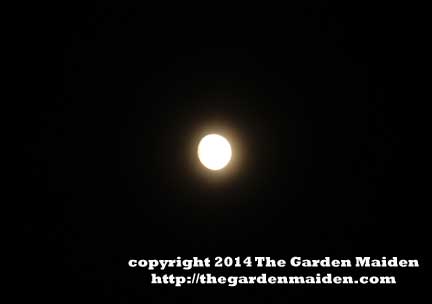
September Super Moon high in the sky. TheGardenMaiden_copyright2014

September Super Moon high in the sky. TheGardenMaiden_copyright2014


In fact, you may venture into the garden after dark, when the moon is high in the sky! Just in time for the September Supermoon, my moonflowers are finally coming into their own.

Moonflower. TheGardenMaiden_copyright2014

Moonflower. TheGardenMaiden_copyright2014


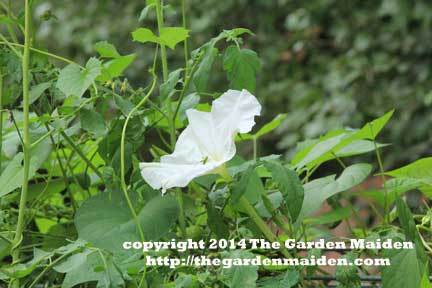
Moonflower, Ipomea alba, is one of my favorite night blooming vines. Though I noted mine are not fragrant (though many report it to be), they are very pretty from dusk (about 6 p.m.) until sunrise.  This is one annual vine I don’t mind tending to. In fact, I am collecting seed for next year as the flower pods dry and the seed is set. (Look for fat brownish pods at the base of the flower (moonflower has a very long style that leads to the ovary where the seeds form).  You can pick seed up most anywhere, but this past winter I purchased mine from Baker Creek Heirloom Seeds in Missouri.

Moonflower. TheGardenMaiden_copyright2014

Moonflower. TheGardenMaiden_copyright2014


I plant some vines near my front porch, some near my back patio and some out on the trellis that connects two of my raised beds. I want to give myself and anyone else visiting the garden the best chance to see these beauties.

Moonflower. TheGardenMaiden_copyright2014

Moonflower. TheGardenMaiden_copyright2014


The moonflower photo above was taken about 10:00 p.m. at night. Moonflower is in the same family (Convulvulaceae) as morning glory, cardinal climber vine, and a few you probably cuss for popping up in your garden.  The Missouri Botanical Garden provides good information on moonflower. Last night I was literally walking around at Midnight, in My Garden of Good and Evils. In fact, I went out barefoot and without a flashlight, holding just my camera. This proved to be a chuckle-worthy mistake as I stepped on something that moved and proceeded to spook myself (of course I had been watching Ghost Adventures and the Dead Files). Talk about a funny moon dance: when you step on something unseen and squishy that moves under your feet and you jump out of your skin.

Hedychium coronarium Butterfly Ginger. TheGardenMaiden_copyright2014

Hedychium coronarium Butterfly Ginger. TheGardenMaiden_copyright2014


In addition to moonflower, hummingbird ginger (Hedychium coronarium) is a highly fragrant, white blooming perennial that is lovely day and night.  I was excited to find it in my south Mississippi patio garden when I moved into my house. White flowers seem to “glow” a bit more in the moonlight. Moon gardens are a fun way to extend your garden enjoyment, especially if you are into evening entertaining! The University of Florida Extension Service has a nice page on this ginger.

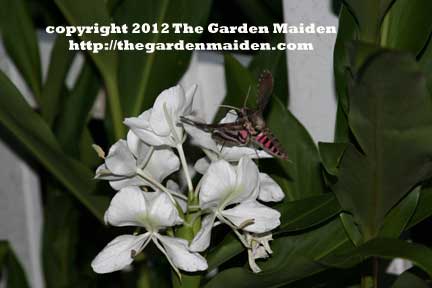
Sphinx moth on Hedychium coronarium Butterfly Ginger. TheGardenMaiden_copyright2012_RStafne_web

Sphinx moth on Hedychium coronarium Butterfly Ginger. TheGardenMaiden_copyright2012_RStafne_web


Be still as you observe fragrant flowers in your night garden and you might see the impressive hummingbird or sphinx moth (yes, it’s the more unique and somewhat beautiful adult form of the tomato hornworm!) as pictured above. This moth also loves my evening blooming four o’ clocks (Mirabilis spp.). Sadly, the winter of 2014 claimed my nightblooming jasmine (Cestrum nocturnum), but fear not, for replacement is ahead for 2015. Check it out on Dave’s Garden.

The next time you look out onto your garden from your recliner, get up, put your shoes on, and remember as Van Morrison sings “It’s a marvelous night for a moon dance”.

“Well, it’s a marvelous night for a Moondance
With the stars up above in your eyes
A fantabulous night to make romance
‘Neath the cover of October skies
And all the leaves on the trees are falling
To the sound of the breezes that blow
And I’m trying to please to the calling
Of your heart-strings that play soft and low
And all the night’s magic seems to whisper and hush
And all the soft moonlight seems to shine in your blush”

Don’t forget, I’m on FB, Twitter, Pinterest, and Youtube…so click the links at the top of the page. Tales from the Hort Side is my FB fan page. Go ahead and give me a “like”.

The Garden Maiden 🙂

All images and text copyright 2014 The Garden Maiden

Categories: Observations from My Garden of Goods & Evils, What's Blooming | Tags: , , , , , , , , , | 2 Comments
Pollinator Gardens.org

Enhancing pollinator habitat through research, education and design

Keep Mississippi Beautiful

Working to inspire and educate Mississippians to take action everyday to impact, improve, and beautify their community environment.

Fire Gardens: fire-generated grassland seed

Louisiana Cajun Prairie and Pine savanna seed

Easy Wildflowers

Wild flowers from The Forest of Dean

Always Growing

A garden is good for both body and soul

In the Garden with Arkansas Extension Horticulture

Welcome to In the Garden with Arkansas Extension Horticulture, a blog about gardening in Arkansas.